Chapter 1B
Decision Framing
 Decision Intelligence – Decision Framing
Introducing Decision Framing

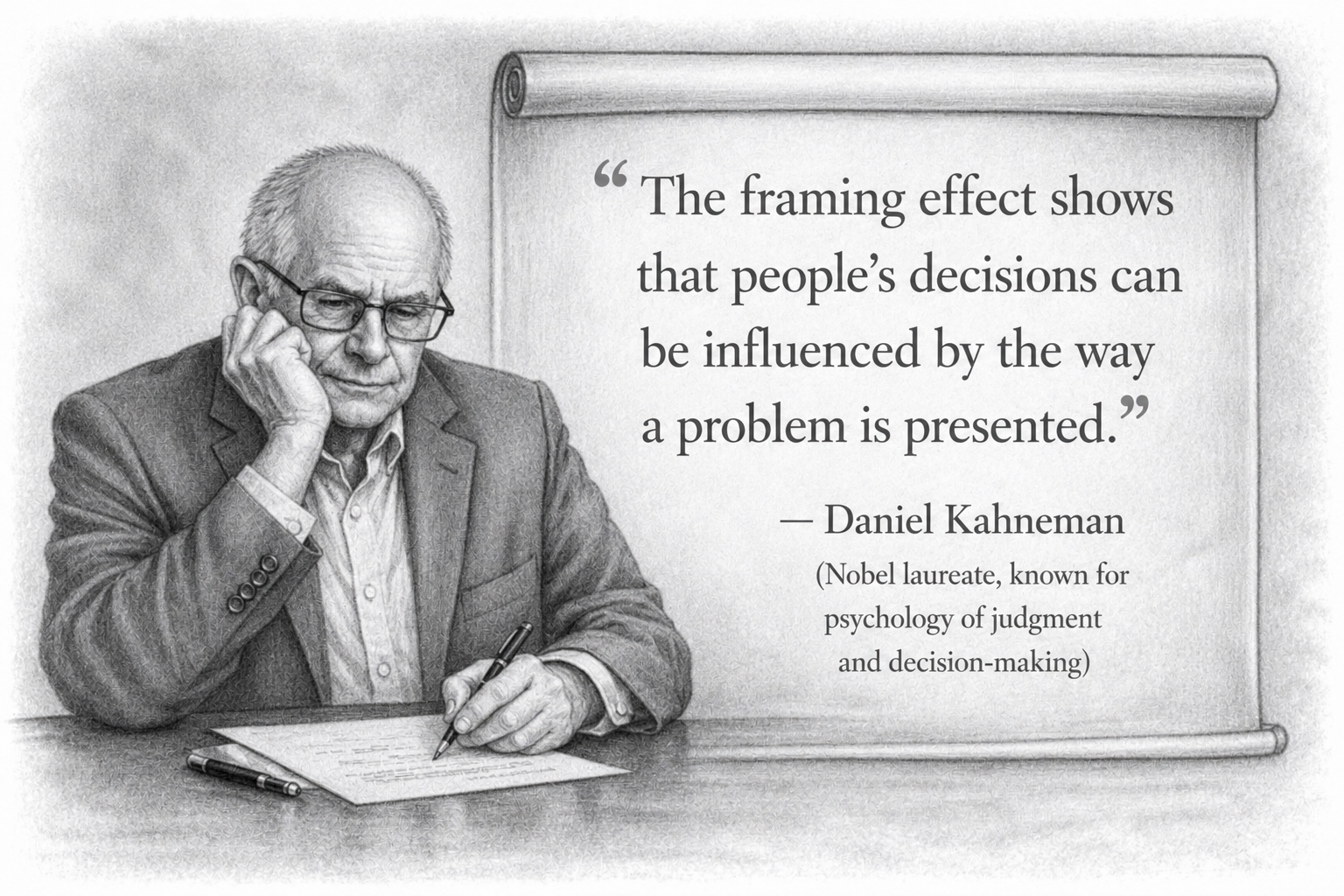
The first step in making quality decisions is defining a problem or opportunity before deciding what to do. It helps decision-makers understand the situation, agree on the objectives, and identify what matters most. A clear frame keeps everyone focused on the right question and reduces confusion or misinterpretation. A strong frame also distinguishes what is within the decision-maker’s control, what should be treated as fixed, and what falls outside the scope of the decision. Approached this way, framing creates a shared understanding of the situation and helps ensure that decision-makers are addressing the right issue rather than reacting only to its most visible symptoms.
Decision framing should not be viewed as a one-time statement written at the beginning of a project. It is often an iterative and collaborative process that improves as new information becomes available and stakeholders test their understanding of the issue. Decision teams may need to broaden, narrow, or restate the frame as they uncover hidden assumptions, conflicting objectives, or overlooked alternatives. A useful frame is broad enough to encourage creative thinking but focused enough to support practical analysis and action.
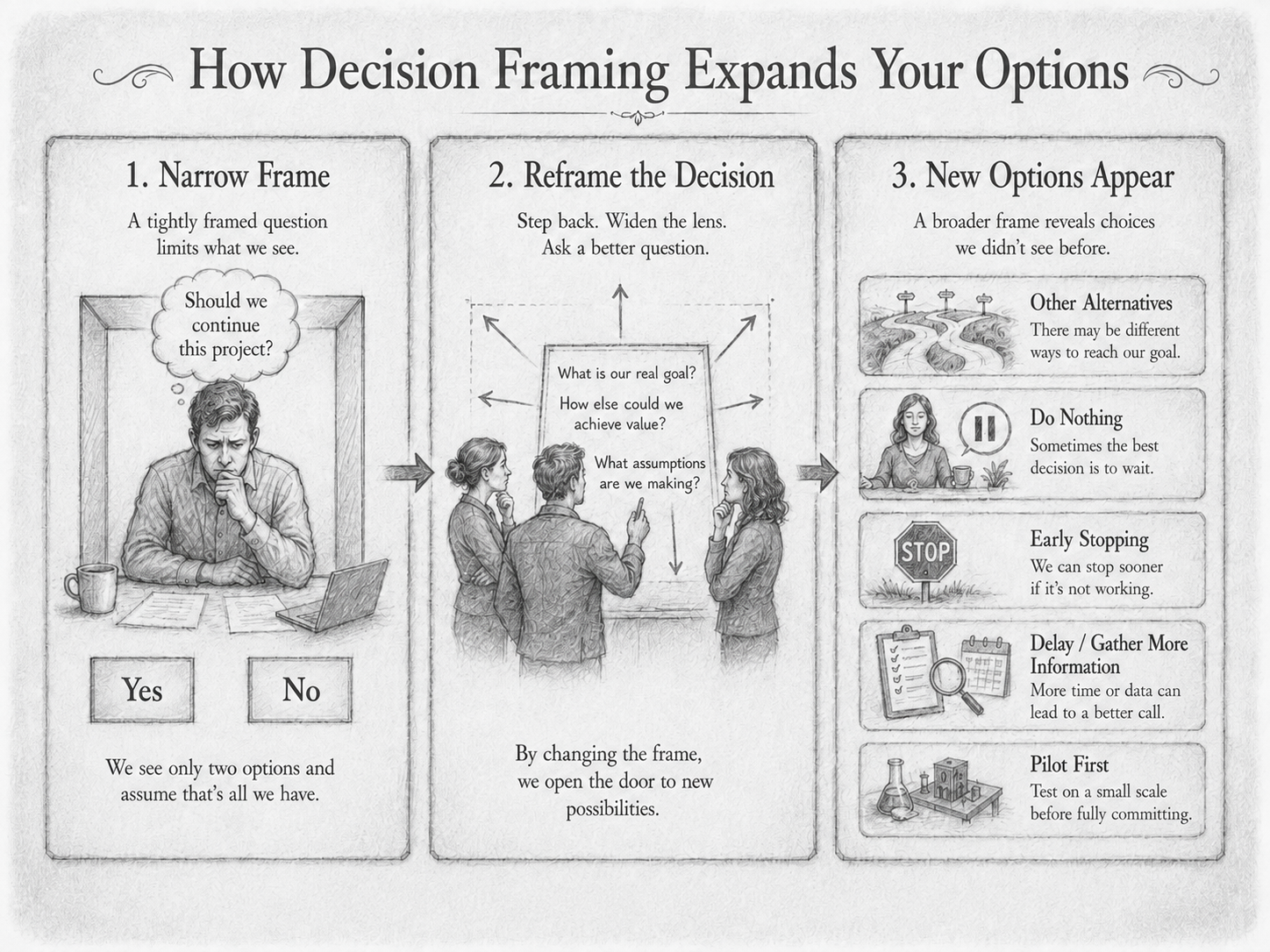
Decision Framing is about thinking or presenting reference points to potentially uncover additional choices. By changing those reference points, we can change which trade-offs stand out and potentially uncover choices that were not visible before.
Consider a decision about whether to accept a new job offer. A job can be evaluated across dozens of factors, including compensation, commute, flexibility, responsibilities, culture, stability, and opportunities for advancement. Yet most people do not examine every factor with equal attention. To make the decision manageable, they simplify it by focusing on a few narrow job data points that seem most important.
In the job decision scenario, suppose the job offer comes with a substantial salary increase but also requires a longer daily commute and more time in the office. Framed primarily as an opportunity for higher pay, the offer may appear highly attractive. Framed instead as a loss of time and flexibility, it may feel far less appealing. Neither frame is necessarily wrong, but each directs attention toward different consequences, risk and opportunity to gather more evidence. These reference points are also personal and contextual. One person may focus on salary, another on the quality of the work, and another on the company’s culture or potential for career growth.
The way you frame your decision can strongly affect your outcome, much like looking at the same picture through different lenses. Each lens highlights different details, changing how you see the whole scene. By paying attention to how you’re framing the decision, you can find better ways to explore your options and possibly uncover new ones. Going back to the high-salary-but-long-commute job example, you might decide to negotiate a hybrid work arrangement instead of pushing for the highest pay. This is a new option you might not have considered if you only stuck to the original frame of “salary vs. commute.”
Framing a decision properly helps you address the core problem, not just a symptom. Many times, we zoom in on a narrow frame and end up solving a smaller issue instead of the more important one. In the job example, if you label the decision as just a “job-offer decision,” you may ignore how it fits into your long-term goals. But if you re-frame the desision as “career goals,” you start to consider whether you should make gradual moves in your field or take this chance to pivot to something more meaningful. Is joining a smaller company for more learning opportunities worth it, or should you chase a higher salary for quick benefits? By widening your perspective, you avoid making a short-term fix that may not support your long-term aspirations. Frames that are too tight can make you miss the core problem, causing you to only patch surface-level issues. On the other hand, good decision framing broadens your viewpoint, opens up fresh solutions, and helps you solve a more meaningful problem in the end.

The simple cartoon on the right shows how two people can experience the same moment in completely different ways. The person stranded on the island is excited to see an approaching boat because it may offer a way to escape being trapped on the island. At the same time, the person rowing the boat is relieved to see land after what may have been a long and exhausting journey. Both people are looking at the same situation, but their circumstances cause them to interpret it very differently.
This example highlights an important idea: the same event can create very different frames, or perspectives, for different people. Philosophy helps us understand why this happens by encouraging critical thinking, logical reasoning, and the examination of problems from multiple points of view. In decision-framing, understanding why people see a situation differently can be extremely valuable. It can reveal hidden concerns, reduce conflict, and help people find solutions that work better for everyone. This ability is one of the major strengths of decision-framing, especially in negotiations, agreements, debates, and other situations where people have competing interests.
Philosophy covers a broad set of concepts including "critical thinking", which teaches one to think carefully and argue logically. Philosophers look at problems from all angles to test if our beliefs make sense. In fact there are complete philosophy lesson plans for students dedicated to understanding decision-framing and perspectives. For example, the "PLATO - Different Perspectives Game" helps students see the world in different ways they normally would not have. While the perspectives game lesson plan is geared towards middle school-aged (primary school) students, it applies to all kinds of critical situations.
Reframing with Alternative Decision Frames
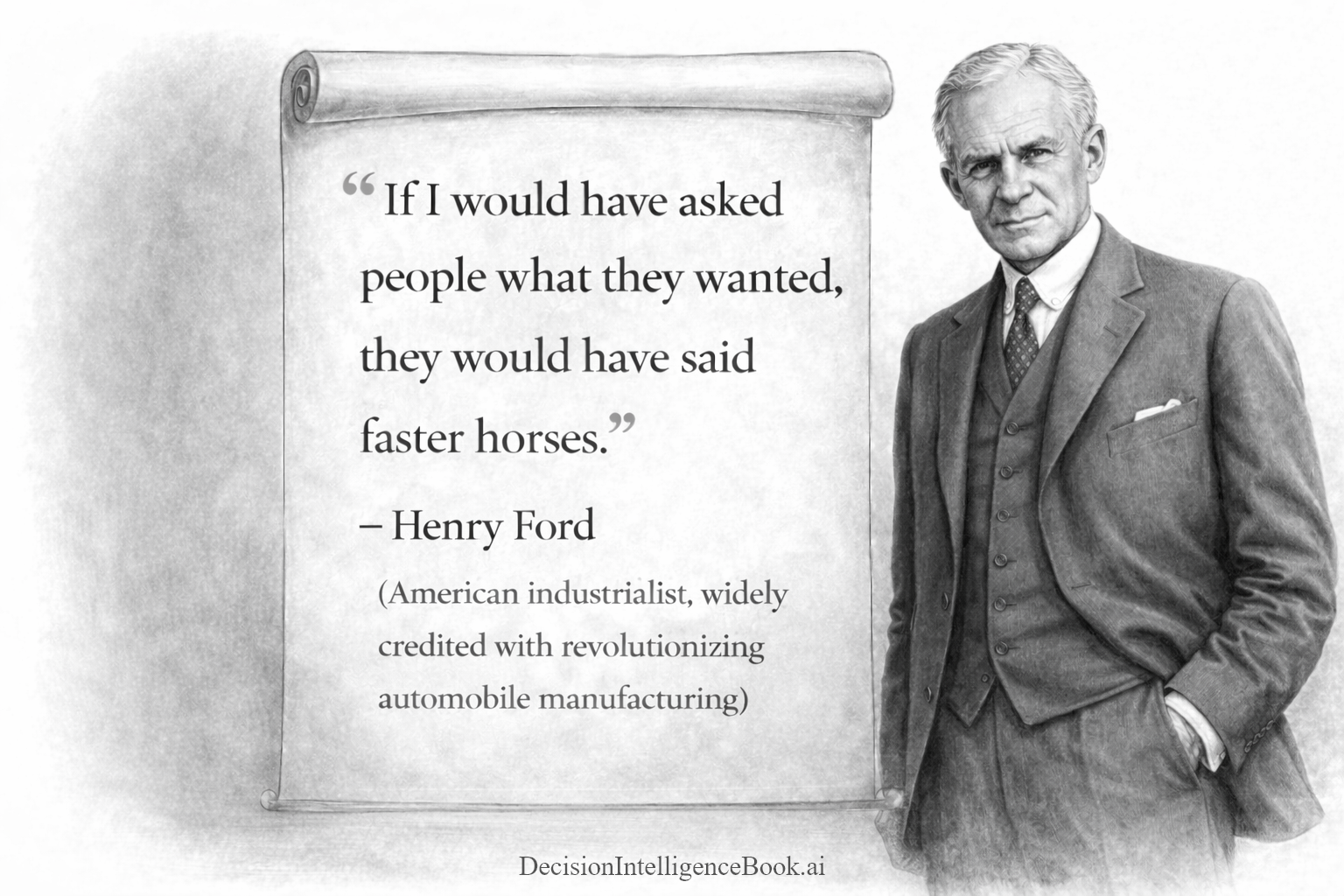
Henry Ford’s famous quote (above) illustrates the importance of decision framing. Decision framing is about how you define a problem and the boundaries you set around possible solutions. Henry Ford claimed if you frame the decision narrowly, simply asking, “How can we improve transportation with horses?”, you’ll likely get incremental, unimaginative answers, like “faster horses.” But by broadening the frame to, “What is the real need here?” (such as faster, more reliable personal transport), you open up space for potential breakthrough solutions, like the automobile.
In most decisions (personal, business) people tend to rely on a single, well-defined decision frame. This frame is often anchored in personal experience or shaped by organizational culture. For example, when deciding on a family dinner, the decision frame might focus on feeding everyone quickly, prioritizing the wishes of the birthday person, or creating a memorable one-time experience. The choice of frame depends heavily on the situation. At an amusement park, for instance, the priority might be to eat quickly so the family can get back to the rides. However, there are times when exploring alternative decision frames is necessary. For example, an established insurance company might realize that its long-standing sales techniques are no longer effective and need to reframe its approach to selling in order to adapt.
To effectively reframe any decision, you can follow these steps:
- Understand the situation and the source of the decision frames
- Generate a list of new alternative decision frames
- Broaden what is being asked
- Analyze the new set of decision frames including the original set and the new alternatives
- Select a list of decision frames to start a decision
📝 Note: Depending on the decision complexity, framing can be done in a single step or it can break down framing into the listed framing sub-steps. This applies whether it is a human performing the decision framing or a Generative AI system. As you will see in further chapters, Generative AI excels at automating and simplifying decision complexity.
Below are some examples of decision frames and alternate decision frames. Notice how the primary and alternate decision-frames can adjust your initial path for making a decision. For simplicity only one alternate has been shown below for each situation, but real-world situations can have several alternatives. In fact, it is a best practice to start the decision making process with multiple decision frames.
| Situation | Decision Frame | Alternate Decision Frame |
|---|---|---|
| New required corporate security training | "Noise" that prohibits you from executing your job tasks. | Opportunity to learn new security innovations. |
| You own a stock that recently dropped 20% | Financial risk & consider selling. The stock is in a free-fall and you might lose a more money if you hold onto the stock. | Do more research. Potential opportunity to buy more and lower total ownership costs. |
| A competitor comes out with a new solution powered by GenAI | Opportunity to modernize & innovate on your own company's solution with GenAI. | Risk to the business that could cannibalize your revenue. |
| A new powerful laptop has been released. Should you purchase it? | Your current laptop is recent and working fine. Need good hardware functionality reasons to upgrade. | Warranty is expiring on your current laptop. What is the risk of it breaking and being stuck with no laptop? |
| The family refrigerator has stopped working | Minimize cost. (Calling a repairman will cost at least $250 for them to come out, but it may not fix the issue.) | Make the problem go away. (A new similar refrigerator cost ~$1,500. Should you spend that amount of money to guarantee solve the issue?) |
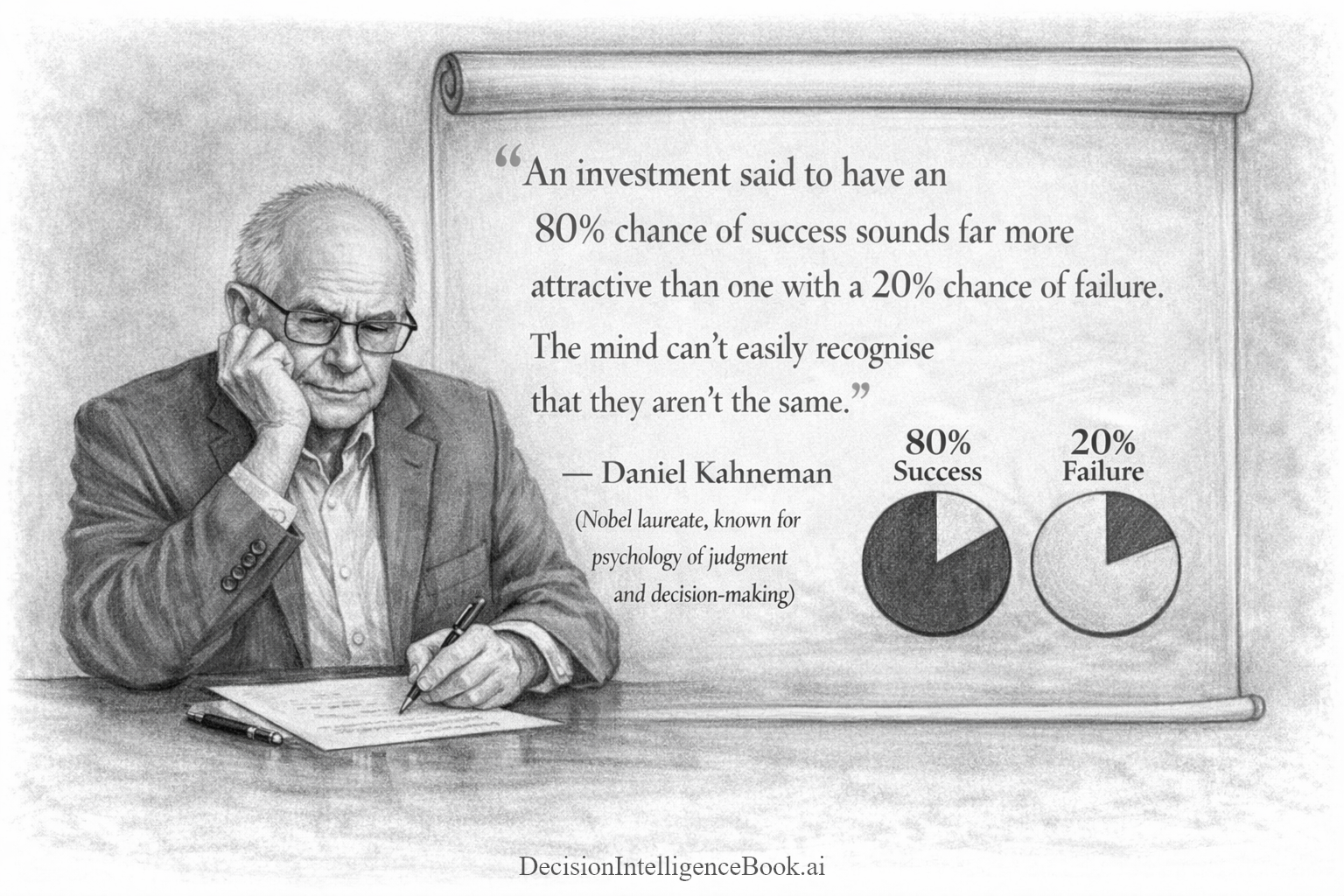
Alternate decision frames can become even more specific, significantly influencing how identical information is perceived. Daniel Kahneman's insight highlights this clearly: simply shifting emphasis from success to failure (or vice versa) can dramatically reshape the interpretation of the exact same probability. When presented with a choice, our brains tend to anchor strongly to the initial frame we encounter, causing us to underestimate or overlook equivalent alternative perspectives. Consequently, the same information, when presented positively, can prompt optimism, confidence, and a willingness to pursue an opportunity, while the negative framing of identical facts can trigger caution, avoidance, or even anxiety.
This cognitive phenomenon arises because our decision-making processes are often intuitive rather than analytical, shaped by emotional reactions, memory associations, and implicit biases. Positive framing implicitly activates mental models focused on potential rewards and gains, aligning our thoughts toward desirable outcomes. Conversely, negative framing emphasizes potential losses or risks, activating mental patterns focused on preventing harm or avoiding undesirable outcomes. Even minor linguistic adjustments, such as describing medical treatments in terms of lives saved rather than lives lost—can profoundly influence the emotional weight we attribute to the information.
The following table illustrates this phenomenon across a range of practical industry scenarios. Notice how each pair of examples reframes identical information either positively or negatively, seeding entirely different narratives and perceptions for the decision-maker.
| Scenario | Positive Frame | Negative Frame |
|---|---|---|
| Finance – Investment Outcome | There’s a 3 in 4 chance this investment will yield a profit. | There’s a 1 in 4 chance this investment will result in a loss. |
| Finance – Payment Method Cost | A store offers a 2% discount for paying in cash. | The store charges a 2% fee for using a credit card. |
| Finance – Insurance Purchase | Framed as protect your home for $300 a year (covers up to $100,000 in damages). | Framed as without a $300 policy, you risk $100,000 in potential losses. |
| Healthcare – Drug Treatment Results | A medication is said to help 70% of patients who take it. | It’s said that 30% of patients see no improvement with the medication. |
| Healthcare – Epidemic Plan | Policy framed as saving 200 lives out of 600. | Policy framed as 400 people will die out of 600. |
| Healthcare – Regular Check-ups | Message: Regular check-ups increase your chances of catching illnesses early. | Message: Skipping check-ups decreases your chances of catching illnesses early. |
| Marketing – Beef Labeling | Beef is labeled as “80% lean.” | Beef is labeled as “20% fat.” |
| Marketing – Cleaning Product Claim | Advertised as kills 99% of germs on surfaces. | Advertised as leaves 1% of germs on surfaces. |
| Nonprofit – Charity Appeal | Tells donors their gift can provide meals and shelter to a family in need. | Warns that without donations, a family may go hungry and homeless. |
| Politics – Tax Cut Description | Promoted as “tax relief” for citizens (emphasizing easing a burden). | Criticized as a reduction in funding for public programs (emphasizing lost benefits). |
| Politics – Employment Stats | Highlights that 95% of the workforce is employed. | Notes that 5% of workers are unemployed. |
| Politics – Climate Policy | Announces a plan will cut emissions by 30% in the next decade. | Points out this still leaves 70% of current emissions unaddressed. |
| Personal – Exercise Benefits | Encouragement: Exercising regularly will improve your energy and health. | Warning: Not exercising increases your risk of fatigue and health issues. |
| Personal – Career Change | Seen as a chance to pursue a dream job and grow professionally. | Seen as leaving a stable job and risking failure. |
| Personal – Asking Someone Out | You frame it as a chance to find love and happiness. | You frame it as a chance of rejection and embarrassment. |
| Personal – Daily Savings | Think of it as saving $5 a day (about $150 a month) towards your goals. | Think of it as losing $150 a month in potential savings by not saving daily. |
Alternative frames are a great starting point and a core concept to master in decision framing. However, alternative decision frames generally only provide one additional frame. Alternative frames are helpful, but you may want to explore multiple decision frame options. Extending this concept, a decision process may cast a wide net across a variety of decision frames and select several to process for decision recommendations.
Decision Framing - Systematic Frameworks
Decision framing is a process that is more structured than most initially assume. There are several decision framing techniques, processes and systematic frameworks that can be applied to improve decision framing such as: Pareto Analysis, the 10-10-10 rule, Pascal's Wager, the Six Thinking Hats etc. These frameworks guide decision makers through clear steps, ensuring that all relevant factors are considered and reducing the risk of overlooking critical information or making impulsive choices. By breaking a complex decision into defined components, frameworks prevent important considerations from getting lost. In a group setting, structured decision framing encourages sharing diverse perspectives in an organized way. Participants can systematically discuss each criterion or option, which reduces misunderstandings and maintains focus on the key issues. The result of incorporating decision-framing techniques is a decision process that is clearer, less biased, and more likely to yield quality outcomes.
There is a great deal of available literature on these techniques and how to apply them for effective decision framing. Therefore, decision framing can be learned, taught to hunans as well as being incorporated by Generative AI systems.
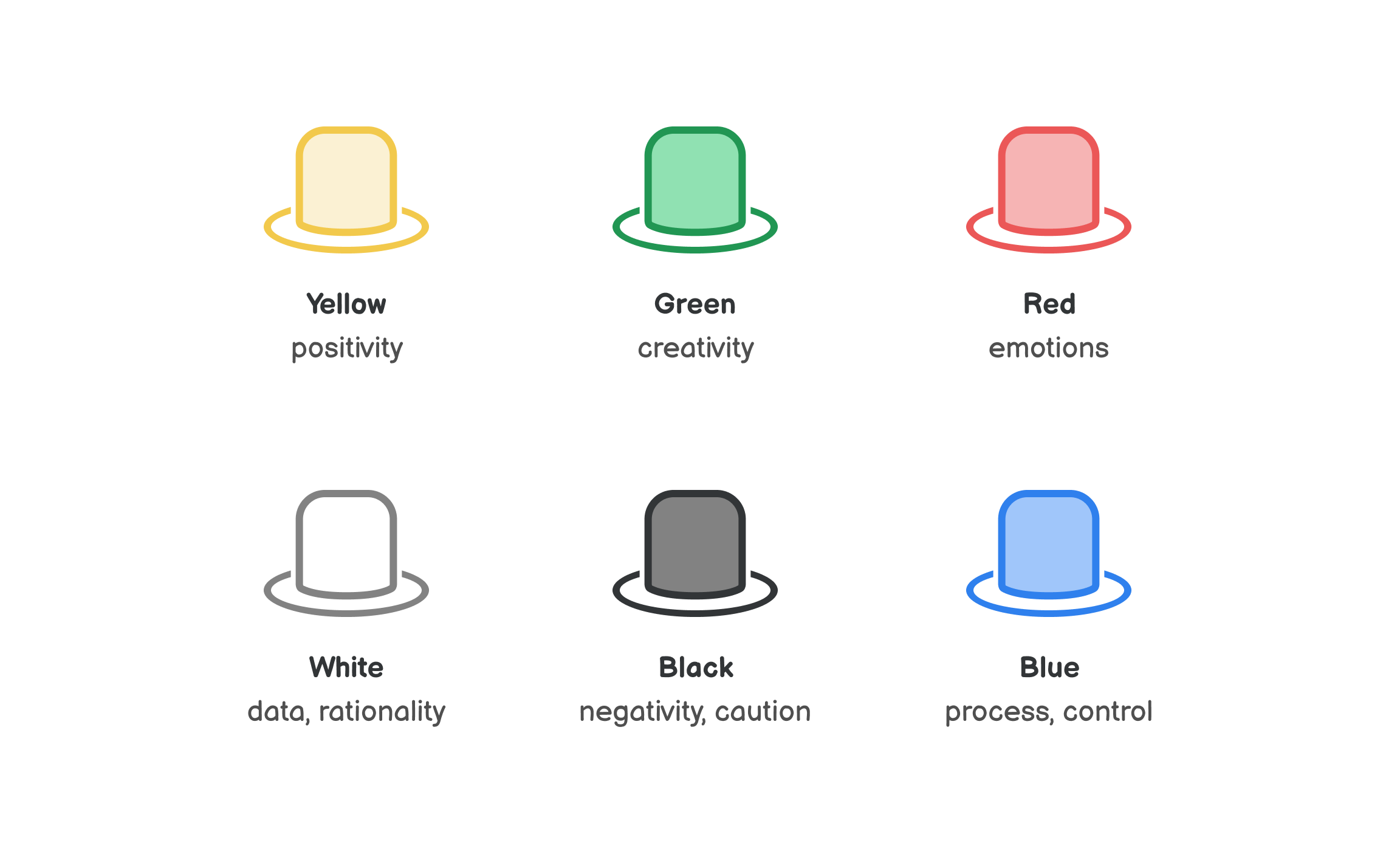
Realistically there can be multiple decision frames in a complex decision. The image on the left illustrates the Six Thinking Hats decision framing technique, which approaches a decision problem from 6 different perspectives: Positivity, Creativity, Emotions, Data/Rationality, Negativity/Caution and Process/Control. Each "thinking hat" looks at the problem in its own way. For example, the green hat looks at the situation primarily from a "Creative perspective". The challenge for human decision makers is that we have inherent biases that are difficult to overcome and place ourselves in another state. If you are having a very poor personal week due to many reasons, it is naturally difficult to come into a new situation from a "Positive" perspective. This is where Generative AI helps immensely. You will see examples in this workshop how this technique can easily be applied to Generative AI decision making, allowing the Generative AI to recommend a path forward in that specific contextual framing.
Decision Framing - Actuarial Thinking
Actuarial thinking is a disciplined methodology of framing decisions comprehsensively under uncertainty. Actuaries are professionals who use mathematics, statistics, financial theory, data, and business judgment to evaluate the quantitative consequences of uncertain future events. Their work is commonly associated with insurance, pensions, healthcare, retirement planning, enterprise risk management, and long-term financial systems. If you have purchased car insurance and wondered “How come I pay this car insurance price and my neighbor pays less?”, an actuary has taken info about you to predict the risk associated with insuring your car ownership. Therefore, actuaries estimate the likelihood and cost of future events, test assumptions, calculate reserves, design policies or strategies, and communicate risk tradeoffs to decision-makers.
For decision framing, actuarial thinking is useful because it forces us to look beyond the obvious framed question of “Which option looks best?” and instead ask, “Which option survives uncertainty?” An actuarial frame examines the time horizon of a decision, the amount of exposure at risk, the volatility of possible outcomes, the assumptions that must hold true, the credibility of the available evidence, the probability of abandoning the plan, and the possibility of rare but severe downside events.
In this book, we will use actuarial thinking not as a technical exercise (no advanced math), but as a general purpose decision frame taxonomy. The goal is to help us reframe decisions around survivability, resilience, and long-term consequences etc. A decision may appear attractive under average conditions, but fail under stress, delay, volatility, weak assumptions, or extreme events. The actuarial lens helps reveal those hidden risks before we commit.
A simple way to summarize actuarial decision framing is: Do not only ask whether a decision works in the expected case. Ask whether the decision works collectively across time, volatility, uncertainty, lapses in behavior, and adverse scenarios. Therefore, multiple decision-frames are being evaluated together as a single decision frame.
One important distinction to understand is that the actuarial framing taxonomy (noted below) components below are used together as a single decision frame. In the earlier section with Six Thinking Hats, you can use the right "thinking hat" or select the most appropriate. For actuarial decision framing, you are using the complete taxonomy of the individual components together.
Actuarial Decision Framing Taxonomy
Below is an actuarial decision framing taxonomy that covers the core approaches an actuary takes when approaching decisions. These decision frames can be used individually. However, together they make up a collective portfolio of frames how an actuary approaches a high-stakes decision.
| Decision Frame | Core Question | Primary Risk |
|---|---|---|
| Time Horizon | How long must this decision remain viable? | Optimizing for the short term |
| Exposure | What—and how much—is at risk? | Taking on an oversized commitment |
| Variance | How unstable could the outcome or decision path be? | Financial, emotional, or operational volatility |
| Assumption Fragility | Which assumption could break the plan if it is wrong? | Hidden optimism or model risk |
| Tail Risk | What happens in a severe downside scenario? | A low-probability, high-impact loss |
| Correlation | What other risks could fail at the same time? | Concentrated or cascading losses |
| Reserves | What cushion is needed if results are worse than expected? | Insufficient capacity to absorb setbacks |
| Optionality | Can the decision be reversed, delayed, or adjusted? | Lock-in under uncertainty |
| Adverse Selection | Who is most likely to accept or respond to this offer? | Attracting higher-risk participants |
The Time Horizon frame considers whether a decision remains sustainable over its full lifespan.
- Retirement: Can the plan support several decades of expenses and uncertainty?
- Product launch: Will the technology and operating model remain maintainable?
- Education: Will the choice create durable skills and future opportunities?
The Exposure frame identifies the financial, operational, reputational, emotional, or time commitments at risk.
- Before personally guaranteeing a business loan, consider which assets and future income are exposed.
- Before relying on one vendor, assess how much operational continuity depends on it.
- Before making a public statement, consider the relationships and opportunities that may be affected.
The Variance frame focuses on the range and instability of possible outcomes rather than only the expected result.
- A commission-based job may offer higher upside but less predictable income.
- Viral marketing may generate rapid growth but highly unstable demand.
- Freelancing may provide freedom while creating uneven cash flow and client uncertainty.
The Assumption Fragility frame tests whether a decision depends too heavily on optimistic or uncertain beliefs.
- What happens if customer adoption takes twice as long as expected?
- Is a home still affordable if income remains flat?
- Does an AI initiative still work if users require extensive human review?
The Tail Risk frame examines unlikely but severe outcomes that could cause lasting damage or ruin.
- What would a major data breach mean for trust, liability, and operations?
- Could one speculative investment materially damage long-term financial security?
- What protection is needed against a major health, disability, or liability event?
The Correlation frame looks for risks that share the same underlying cause and may fail together.
- An employee may lose both income and investment value if they hold substantial employer stock.
- A startup dependent on one platform may lose revenue and customer access at the same time.
- Two household incomes in the same industry may be vulnerable to the same downturn.
The Reserves frame asks what buffer is needed when actual outcomes are worse than expected.
- How much personal and business runway is needed before leaving a job?
- What budget and schedule contingency should support a major transformation?
- How much cash should remain after purchasing a home?
The Optionality frame considers whether a decision preserves the ability to change direction.
- Can a long-term software contract be exited or adjusted?
- Does a specialized career path preserve future alternatives?
- Could phased hiring reduce commitment before product-market fit is established?
The Adverse Selection frame asks who is most likely to accept an offer when participants know more about their own risk or behavior than the decision-maker does.
- Unlimited revisions may attract clients with unusually high demands.
- Very low prices may attract customers who are costly to serve.
- A vague job description may attract candidates comfortable with unclear roles rather than those best suited to the work.
Decision Framing - Using Generative AI
While the topic of Decision Framing is very approachable and teachable, to master decision framing one needs to gather decision framing literature, consume it, internalize it and practice applying decision frames in the real decision situations. This is not easy to accomplish quickly. However, the power of Generative AI decision framing can help. The great news is that these decision framing techniques are either built-in to the GenAI model knowledge or the model can be provided (with additional context) with new decision framing techniques. Generative AI allows someone to quickly find, apply and create decision framing scenarios. Furthermore, this allows for creating Generative AI systems with sophisticated and configurable decision framing processes that are highly tailored to organizational operations.
Four key areas where Generative AI can enhance Decision Framing:
- Reduce Human Biases in Decision Framing
- Provide Alternate Decision Frames
- Suggest Systematic Decision Framing Algorithms
- Apply the most Appropriate Decision-Frames (from a wide corpus of frames)
1. Reduce Human Biases in Decision Framing
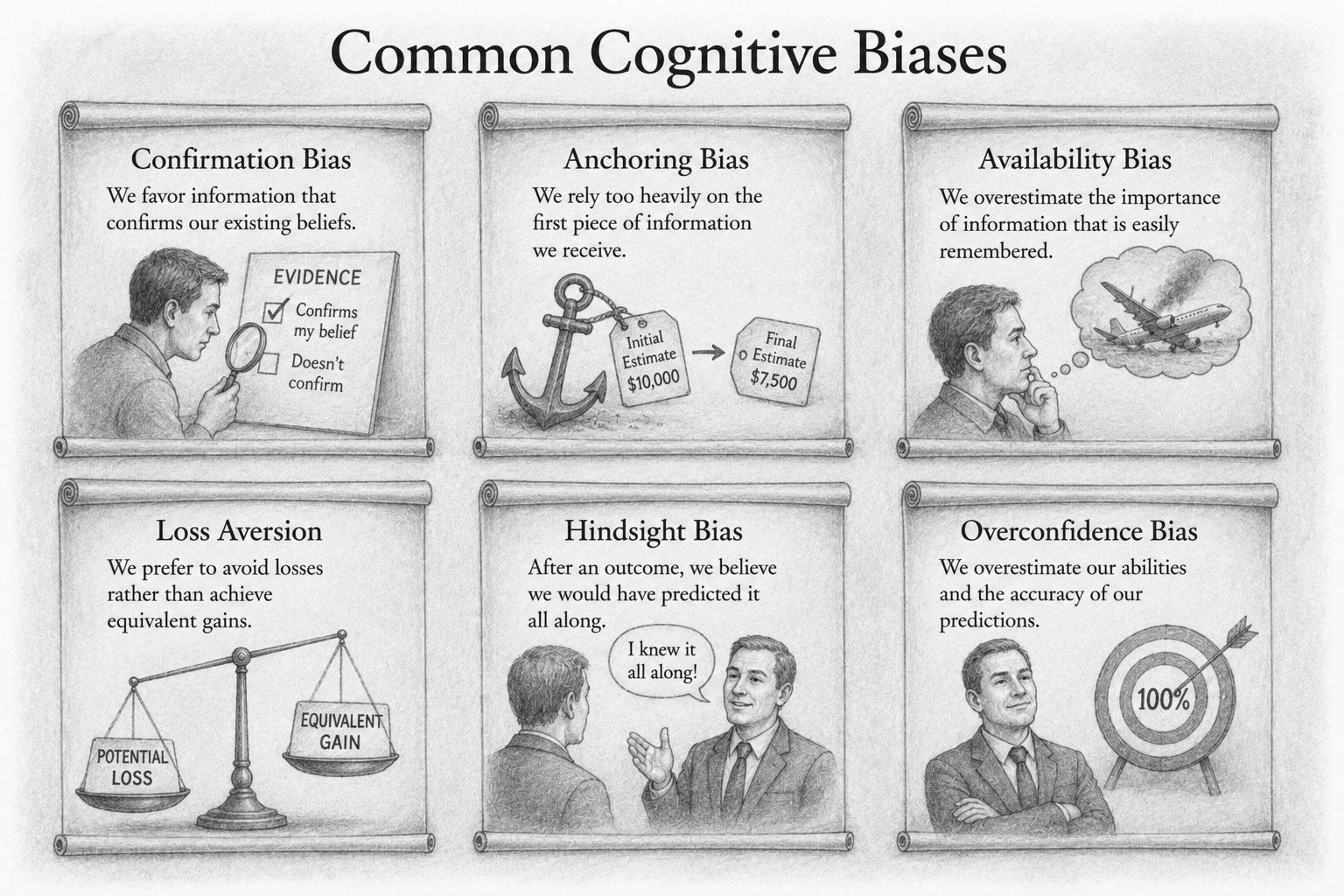
Human decision-makers are prone to cognitive biases that narrow their thinking. There are dozens of documented cognitive biases that can effect decision-making. For example, people tend to ask questions that confirm our assumptions (confirmation bias), give undue weight to recent information (recency bias), or stick with the group’s view (groupthink), often framing decisions too narrowly. Generative AI systems are not a human, they don't have souls, they don't have feelings. This makes these systems ideal to mitigate many biases by analyzing vast amounts of data objectively, identifying potential blind spots or overlooked perspectives without the emotional attachment or predispositions humans naturally possess. Furthermore, Generative AI can counter these biases by offering an outside perspective and control for bias. Controls for bias can be implemented with proper context engineering techniques and monitored during Artificial Intelligence output evaluations.
2. Provide Alternate Decision Frames
Generative AI excels at generating alternative perspectives on a problem, essentially reframing questions in novel ways. Rather than sticking to a single viewpoint, AI can dynamically suggest multiple frames, leading humans to see new solutions. Therefore, Generative AI can significantly expand the scope of decision framing by rapidly generating alternative viewpoints and perspectives that humans might not immediately consider. By simulating multiple scenarios, Generative AI can suggest novel or non-obvious frames, encouraging decision-makers to think beyond initial assumptions or conventional wisdom. For example, an AI model might suggest viewing a challenging business decision from a customer-experience angle, an ethical angle, or through the lens of long-term sustainability.
3. Suggest Systematic Decision Framing Algorithms
An AI decision system can first examine the decision environment before recommending how the situation should be framed. It can consider the decision objective, available information, uncertainty, constraints, stakeholders, time horizon, and potential consequences. Based on this context, the system can then suggest which structured decision framing methods are most appropriate.
For example, a cost–benefit analysis may be useful when the main challenge is comparing measurable advantages and disadvantages. A SWOT analysis may be more appropriate when the decision depends on internal capabilities and external conditions. Multi-criteria decision analysis (MCDA) can help when several options must be evaluated across competing criteria, such as cost, quality, risk, and long-term value. For decisions involving uncertainty or severe downside consequences, the system may recommend methods such as scenario analysis, sensitivity testing, or an actuarial risk frame.
In this role, Generative AI does not simply select the same framework to every problem. It acts as a framing assistant that interprets the situation, identifies the most important characteristics of the decision, and recommends a suitable portfolio of methods. This helps decision-makers avoid forcing a complex problem into an inappropriate framework and provides a more organized view of the available options, trade-offs, assumptions, and risks.
4. Apply the most Appropriate Decision Frames
Once the relevant decision frames have been identified, AI can help apply them consistently and effectively to the problem at hand. Complex decisions may require a risk-management or opportunity-pursuit frame, a quantitative or narrative approach, or a short-term or long-term perspective. In many cases, several frames may need to be applied together.
Generative AI can analyze the decision context, objectives, constraints, stakeholder perspectives, historical outcomes, and available evidence to determine how each selected frame should be used. It can structure the analysis, generate frame-specific questions, identify assumptions, evaluate alternatives, and compare the conclusions produced by different perspectives.
For example, AI can conduct a premortem for a high-risk project, perform a cost-benefit analysis for an investment decision, or apply the Six Thinking Hats method to explore a multifaceted issue. It can also rank frames by relevance, recommend a combination of complementary approaches, and highlight where different frames produce conflicting conclusions. By translating decision frames into structured analyses, AI strengthens the alignment between the decision challenge and the framing methodology, helping decision-makers reach more relevant, balanced, and well-supported judgments.
Framing Teams with AI Members (Agents)
In previous sections in this chapter, teams or decision-making teams where discussed. As you read those sections, you probably pictured human teams collaborating together on a decision. However, Generative AI systems can also directly take part in these teams. Generative AI members (agents) can be treated as a member of the decision-making team. In a cohort, committee, panel, or working group, an AI agents may take on a defined role such as an adviser, evaluator, challenger, facilitator, or even one of several judges assessing the available options. AI agents can offer an additional perspective, apply agreed-upon criteria consistently, question assumptions, compare alternatives, and identify risks or possibilities that human participants may overlook. In this role, AI agents become part of the group’s decision process while human members remain responsible for determining how much authority its judgments should carry.
Because AI is participating in the decision rather than simply recording or summarizing it, the initial decision framing phase becomes especially important. The human and AI members must establish the decision question, shared objectives, evaluation criteria, boundaries, values, and rules that will guide both human and AI participants. AI’s role should be defined clearly: Does it advise the group, cast a vote, rank alternatives, challenge the majority, or act as an independent judge? Without this foundation, the AI may evaluate the wrong problem, rely on unclear standards, or influence the group in ways that participants do not fully understand.
A strong "human & AI better together" foundation also requires transparency and trust. The group should understand what information the AI receives, what assumptions shape its responses, how its recommendations will be reviewed, and when its judgment can be challenged or overruled. AI should not be treated as a neutral or unquestionable authority simply because it can respond quickly or confidently. Like every other member of a decision group, it brings a particular perspective and certain limitations. Decision framing makes those roles and limitations visible, allowing people and AI to work together as a more thoughtful, accountable, and effective decision-making team.