Chapter 1J
Enterprise Decision Intelligence
 Decision Intelligence – Enterprise Decision Intelligence
Enterprise Decision Intelligence
Implementing decision-making systems in an enterprise is really about making decisions repeatable, observable, explainable, and scalable. What does this mean? This essentially means taking the Decision Intelligence process introduced in the previous modules and adding the appropriate enterprise controls as your organization starts to make decisions.
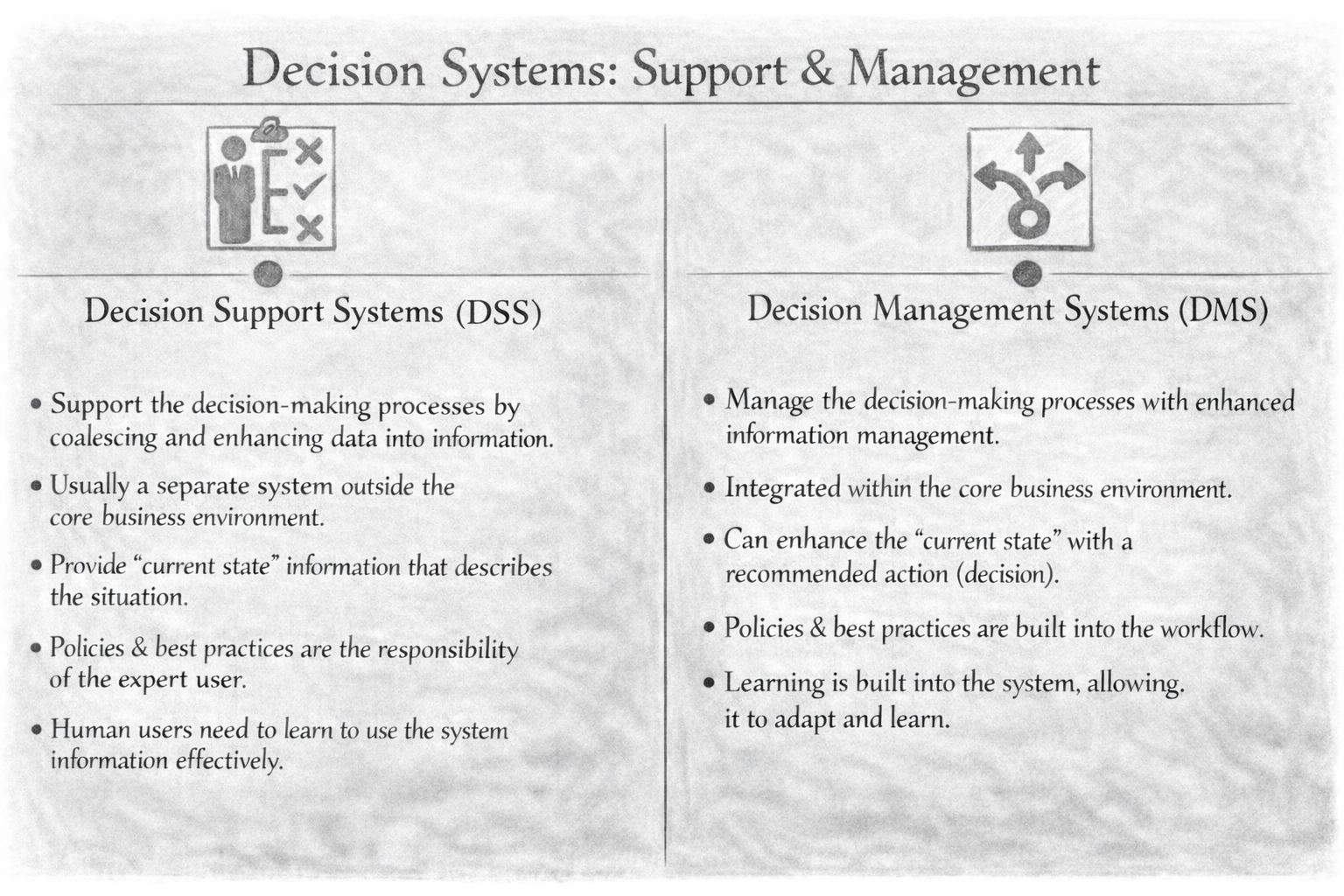
A practical way to introduce organizational decision work is to recognize there are two main archetypes of enterprise decision systems: systems that support human decision-makers and systems that manage decisions by automating them. A decision support system (DSS) is designed to improve decision-making by evaluating the decision solution, running through a decision process and making a recommendation to a decision maker. The actual decision execution is up to the decision-maker. A decision management system (DMS), in contrast, focuses on processing automated decision-making, and it explicitly differs from DSS by aiming to automate the decisions.
DSS and DMS systems are both important when operationalizing Decision Intelligence in an enterprise organization. Organizations new to decision intelligence will typically start with some form of Human-in-the-loop (HITL) set of systems that I call "Decision Support System light". HITL systems typically offer very basic decision-making governance and have rudimentary human intervention techniques. HITL systems can progress and mature into a full enterprise DSS. Most companies serious about decision-making will deploy both systems in conjunction and rarely do you find only one type of system in a large organization. In a simple example, high-stakes decisions where human subject matter experts need to execute the final decision are typically implemented as decision support systems (DSS). Conversely, highly repetitive decisions that are lower risk will typically be automated with a decision management system (DMS).
Enterprise decision intelligence controls around security, compliance, governance, decision provenance/lineage etc. will depend on which type of decision intelligence system you are building.
Decision Support System (DSS) Characteristics
Decision Support Systems are designed to support decision-making by helping organizations execute Decision Intelligence recommendation processes. In practice, they’re often deployed as a separate system outside the organization’s core business environment, functioning as an adjacent layer that teams can consult when they need decision clarity. A DSS typically focuses on producing “current state” framing, intelligence gathering and proposing decision options.
Because DSS tools emphasize informing rather than enforcing, policies, regulations, and best practices remain the responsibility of the expert user. The system provides the inputs and visibility, but people must apply their judgment, domain expertise, and governance rules themselves. As a result, human users are expected to learn how to use the support system information effectively, including interpreting outputs correctly, validating assumptions, and translating insights into action.
A DSS is most valuable when it’s treated as an augmentation of expert judgment, not a replacement for it. The system can surface patterns, uncertainties, and scenario outcomes, but the policies, regulations, and best practices that govern what should be done typically remain the responsibility of the decision maker (or the team) interpreting the output. That means organizations often invest in user training and decision workflows so people learn to read the system’s information efficiently—understanding assumptions, checking data quality, and translating “here’s the situation” into “here’s the right action,” given the organization’s constraints and responsibilities.
Notice the example below where a doctor is looking at a patient's x-ray of a shoulder that highlights an area and probability of a fracture. In this case AI is helping form a doctor's decision on next treatment steps. The AI is not in the position to make the decision, but influence it.

Decision Management System (DMS) Characteristics
Decision Management Systems (DMS) are designed to manage and operationalize decision-making by embedding decision logic directly into business workflows. They often combine business rules with analytics and artificial intelligence to determine the most appropriate action in a process. In practice, a DMS is used to model, manage, and automate repeatable business decisions so decisions can be executed consistently and quickly at scale, with software making (or strongly recommending) the decision rather than leaving it solely to a human in the moment.
Because DMS tools emphasize execution, governance, policies, regulations, best practices they typically synthesize the decision workflow into the business processes. This enables explicit decision logic (often packaged as “decision services”) that can be invoked by enterprise applications. This approach treats decision logic as a managed asset: organizations can author and run decision services, keep decision-making accessible to applications, and manage business logic more independently from surrounding systems. In properly designed DMS implementations, the decision logic is meant to be easier to find and change when policies or regulations shift without sacrificing compliance. This is natural as the decisioning is designed to be transparent and traceable.
A DMS can also go beyond describing the “current state” by enhancing it with a recommended action (the decision), effectively connecting insight to execution. Importantly, policies, regulations, and best practices are built into the decision workflow process, so governance is embedded rather than left entirely to user interpretation. Finally, learning is built into the core of the system, allowing it to actively improve over time—refining decision rules, adapting to new data, and strengthening outcomes as conditions change.
In the image below, an autonomous AI decision system is illustrated. If you have ever taken an Uber before, each driver's business is on their cell phone. For safety reasons, Uber partnered with Microsoft AI to automate the identity of the Uber driver using facial characteristics. AI in this case manages the full workflow and the final decision to verify the driver. What is interesting this Decision Management System (DMS) evolved from a manual process that involved humans, which was not scalable as Uber scaled their business globally.

Core Enterprise Decision Artifacts and Assets
Regardless of whether an organization implements a DSS or DMS, an enterprise decision system is not just a model, prompt, or following the Decision Intelligence workflow. It is a managed collection of decision assets that make decisions repeatable, auditable, calibratable, and improvable over time. In practice, the following artifacts typically need to exist:
- Decision records: Each decision step creates information on that step that is valuable to persist. Structured records of the decision frame, who or what made the recommendation or decision, the options considered, confidence or probabilities, assumptions, constraints, evidence used, final outcome, and timestamp. Decision records are the foundation for explainability, learning, and compliance because they preserve why a decision was made at a specific moment.
- Example: In Software Architecture, decision records are quite important as there are typically many evolving ways on how to approach a solution. Understanding the software engineers' mindset or thought process is fundamental to understand how the solution is formed.
- Decision audits: Audit assets capture how a decision process was executed and whether it followed policy. For human decisions, this may include approver identity, review comments, overrides, exception justifications, and separation-of-duty checks. For AI-assisted or AI-automated decisions, this may include prompt or workflow versions, model versions, grounding data, tool calls, safety checks, guardrail results, and whether a human accepted or overrode the AI recommendation.
- Decision calibration evaluations: Enterprise systems need ways to measure whether human experts and AI systems are well calibrated, meaning confidence levels line up with actual outcomes over time. Calibration assets often include probabilistic forecasts, confidence scores, threshold policies, Brier score evaluations, and benchmark datasets used to compare decisions across people, teams, and models.
- Example: If my sales team is forecasting confidence 20% of the pipeline deals will close in the next quarter. Was the sales team close to the 20% close rate, or where they overconfident or underconfident?
- Decision policies and rules: Explicit policies, business rules, risk thresholds, escalation criteria, and regulatory constraints that govern what decisions are allowed and when a case must be routed to a human.
- Example: Different decisions may require different policies to be effective. In a private equity scenario, a proven decision model that shows 10% successful outcomes can be ideal. However, 10% is woefully inadequate as a decision threshold in most scenarios.
- Decision models and services: The reusable assets that actually execute or support the decision, such as decision trees, rules engines, optimization logic, ML models, LLM prompts, orchestration flows, and API-based decision services.
- Decision evidence and provenance: Versioned datasets, features, knowledge sources, retrieved documents, and lineage metadata showing where the supporting intelligence came from and what versions were used.
- Decision monitoring and feedback loops: Outcome tracking, drift detection, SLA metrics, bias and fairness checks, exception rates, override patterns, and post-decision reviews that help the organization improve its decision process over time.
These components are important in both support and management systems. However, these components play different roles. In a DSS, many of these assets help a human decision-maker interpret and justify a recommendation. In a DMS, the same assets usually need to be more formalized because the system is responsible for executing or triggering the decision automatically.