Chapter 1H
Decision Communication
 Decision Intelligence – Decision Communication

Decision communication is at the core of how decisions actually turn into results. Making a choice in your head is only the first half of the work. What truly shapes outcomes is how clearly that choice is shared with the people who need to understand it, act on it, or support it. This happens constantly in everyday life, whether we notice it or not: a quick “I’ll grab the kids at 5” prevents confusion, a manager’s “We’re delaying the launch by two weeks” resets priorities, and a doctor’s “Here’s why we’re changing your medication” builds trust and follow-through. Therefore, decision communication is the practice of articulating the decision reasoning and the expected outcome. Without that shared understanding, even excellent decisions can stall, fragment, or quietly fail.
Effective Decision Communication Framework Examples
Rasiah Framework - Measure Communication Evasiveness
The Rasiah framework is a simple way to make sure a decision is communicated clearly and doesn’t get misunderstood. The primary goal is to avoid being evasive when using this framework. This means you don’t talk around the decision, use vague words, or leave people guessing. When people are evasive, they often skip the “why,” hide the trade-offs, or avoid saying who is responsible, which creates confusion and mistrust. This framework helps you explain not only what was decided, but also the key details people need to act with confidence. In Rasiah, you share the Reason for the decision, the alternatives you considered, the scope of what’s included (and what’s not), the impact on people or plans, the action steps and who owns them, how you’ll track progress and when you’ll review the decision. Using Rasiah keeps messages short, complete, and easy to follow, so teams stay aligned and move faster.
The Rasiah framework works by classifying responses into three key categories:
- Direct Answer: The communicator provides the requested information
- Intermediate Response: “In-between” cases: the speaker responds partly or only to one part of a multi-part question, or answers by implication/suggestion without being straightforward
- Evasion: The speaker doesn’t give the requested information (e.g., deflects, refuses, changes topic)
Imagine a scenario where during a company town hall an executive is communicating a company-wide decision around layoffs. For anyone with a long career has probably experienced this several times. Depending on how effective and direct that decision is being communicated by the executive, this can look quite differently. For example, the question could sound something like this:
“Are layoffs happening in our team? How many people? When will we know? What support will affected people get? What should the rest of us do right now?”
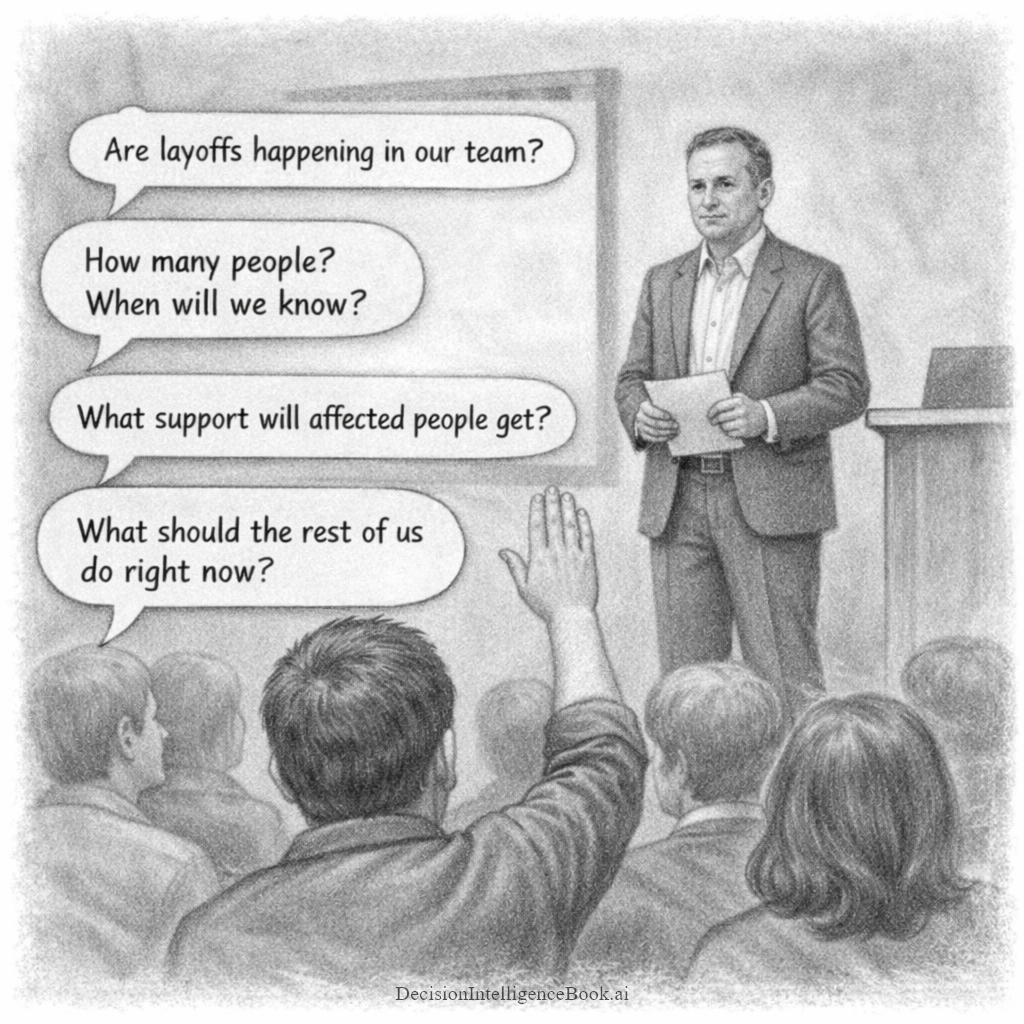
Rasiah framework classifications of example answers:
- Direct Answer: Yes, layoffs are happening because our costs are higher than our revenue growth, and we need to reduce spending this quarter. This impacts our org and two others. In our org, 12 roles are being cut, mostly in Operations and Program Management. Engineering on Project Atlas is not in scope. People affected will be notified this Friday by 2pm, and their access will change the same day for security reasons.
- Intermediate Response: We’re making changes because the business climate is tough and we need to be more efficient. Some teams will be affected, including parts of our org. Leaders and HR are working through details. We’ll share more when we can.
- Evasion: We’re always reviewing priorities to stay competitive. I can’t comment on specific teams or numbers. Let’s stay focused on delivering results this quarter.
Notice the difference between how crisp & concise with information the Direct Answer communication is versus the Evasive answer. This sceanrio is obviously tough, where people's jobs are potentially impacted. However, which communication do you think will be appreciated by the employees?
Minto Pyramid - Top Down Communication Structure
The Minto Pyramid is a simple way to organize your message from the top down so people get the point fast. Instead of building up to your conclusion, you start with it right away (your main takeaway or recommendation), then you share a few key points that explain why, and only after that do you add the supporting details like facts, numbers, or evidence. This works well because most people are busy and don’t want to dig through a long message just to find the main idea. It also lets readers stop after the key points if that’s enough, and only go deeper if they need the proof.
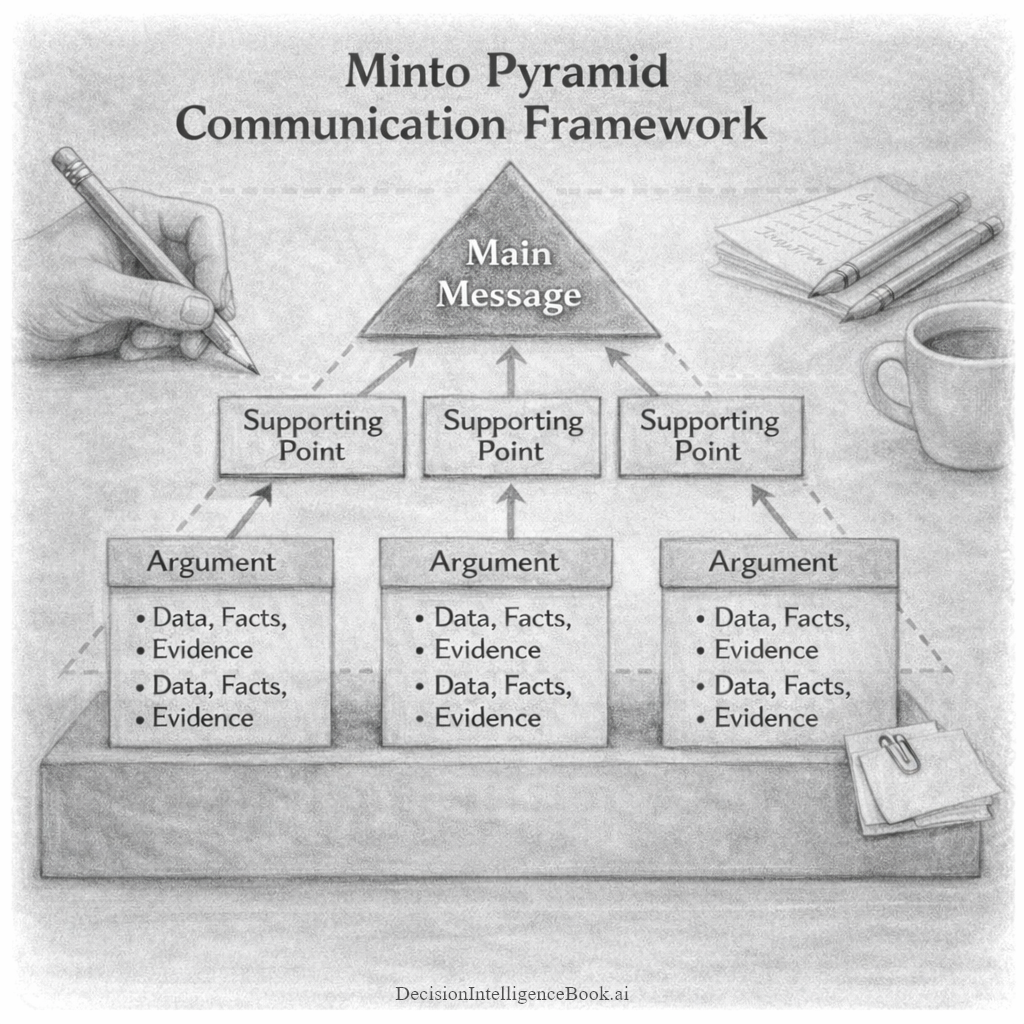
The Minto Pyramid can be used to communicate decisions. To communicate a decision using the Minto Pyramid, start by stating the decision up front in one clear sentence (the “conclusion”), so nobody has to read to the end to find out what was decided. Then add a short set of key points that explain why you chose it—your main reasons, trade-offs, or what you’re optimizing for—kept as brief summaries. Finally, include the supporting details (facts, data, evidence, or background) for anyone who needs to validate the reasoning or implement the change. This top-down structure makes the message faster to understand, easier to agree on, and practical for busy readers who may only skim the top section.
Situation-Behavior-Impact-Recommendation (SBIR) - Judgement-Free Difficult Decisions
The Situation-Behavior-Impact-Recommendation (SBIR) framework is especially useful when a decision is emotionally sensitive, feedback-oriented, or likely to create friction. Where the Minto Pyramid is ideal for top-down clarity, SBIR is better when you need to explain a difficult decision without sounding accusatory or personal. It works by separating the situation, the observable behavior, the impact created, and the recommendation or next step. That structure keeps the communication grounded in facts and consequences rather than vague criticism. This is also why SBIR becomes a strong bridge into later workshop exercises where Generative AI is used to structure hard decision conversations.
For example, imagine a leader deciding to move a troubled release from a normal team cadence into weekly executive oversight. An SBIR-style explanation could sound like this: Situation: Over the last three sprints, the integration milestone slipped each time. Behavior: Dependency risks were surfaced only after sprint reviews instead of when they first appeared. Impact: This delayed launch planning and created uncertainty for Sales and Support. Recommendation: The release will now be reviewed weekly with explicit dependency owners until delivery stabilizes. The message is still firm, but it stays focused on observed reality and the next action rather than turning the communication into blame.
Audience and Stakeholder Adaptation
Even when the decision itself is fixed, the communication should change based on who is receiving it. Executives usually need the decision, business impact, main risks, and review timing. Managers need ownership, dependencies, sequencing, and immediate next steps. Affected individuals need clarity, empathy, timing, and a clear understanding of what changes for them personally. One of the most common communication mistakes is assuming one perfectly worded message works equally well for every stakeholder.
Imagine a product launch is being delayed by four weeks because reliability testing uncovered critical issues. For executives, the communication should be short and answer-first: the launch is delayed, the main business impact, the risk being avoided, and the next review date. For managers, the message should focus on re-planning, cross-team handoffs, and who owns each recovery action. For affected employees, partners, or customers, the message should explain what is changing, why the change is being made, and what support or updated expectations they can rely on. The decision is the same in every case, but the message shape changes based on what each audience needs to understand, decide, or do next.
Communicating Uncertainty, Confidence, and Trade-Offs
Great decision communication should rarely stop at simply saying, "we recommend X." Strong communication also explains how confident you are, what assumptions could change the answer, what trade-offs are being accepted, and when the decision should be revisited. This matters because a recommendation without uncertainty can sound more certain than the evidence actually supports, especially in forecasts, strategic planning, and AI-assisted decision systems.
For example, saying "We should launch the new feature next month" is a weak communication because it hides confidence and conditions. A more calibrated version would be: "We recommend launching next month with moderate confidence, assuming the final security review passes and support staffing remains on plan. The trade-off is faster customer learning versus a slightly higher operational risk. If defect rates exceed our threshold in testing, we should revisit the launch date." This style helps people understand what is known, what is uncertain, and how the decision will be monitored. It also prepares the reader for later workshop ideas around probabilities, model confidence, and Brier-style validation.
Related communication lessons come from Gerd Gigerenzer’s work on risk literacy and John Allen Paulos's work on math illiteracy. Both of these quantitative thought leaders make the valid claim most people are poor at understanding risk and math. Therefore, people often understand uncertainty better when probabilities are translated into natural frequencies rather than abstract percentages or odds. Instead of saying “there is a 0.1% chance,” communicators can say “about 10 out of 10,000 people.” Instead of saying “the model has a 2% false positive rate,” they can say “about 200 out of 10,000 cases may be flagged incorrectly.” This format makes the scale of the risk easier to picture and reduces the chance that people confuse relative risk, absolute risk, base rates, and conditional probabilities. Gigerenzer’s research is especially associated with showing that natural frequencies can make Bayesian reasoning and medical-risk communication much easier to understand. John Allen Paulos’s work on innumeracy adds another useful principle: decision communication should make quantities explicit rather than hiding behind verbal confidence. Words such as “rare,” “likely,” “material,” or “high risk” can mean very different things to different readers. A more numerate recommendation gives the approximate probability, the relevant denominator, and a comparison point. For example, instead of saying “customer churn is unlikely to rise materially,” a stronger version would say, “In our last six launches, churn increased by more than two percentage points once. That suggests this is not the most likely outcome, but it is plausible enough to plan for. For decision purposes, we estimate the risk at roughly 10 to 15 out of 100 similar launches.” Paulos’s broader warning is that people often misread risk, coincidence, and scale when numbers are missing or poorly framed.
This matters for decision communication because many business recommendations involve small probabilities with large consequences. A statement like “there is only a 0.05% chance of a severe outage” may sound negligible, but “about 5 in 10,000 similar launches could experience a severe outage” invites a more concrete illustration about whether the organization can tolerate that risk. The goal is not to make every communication more cautious, but to make uncertainty more legible. When leaders can see the expected count, the affected population, and the trade-off in plain terms, they are better equipped to decide whether to proceed, add safeguards, run another test, or revisit the decision later.
Uncertainty & Risk Communication Examples
| Context | Weaker Uncertainty Communication | Improved Uncertainty Communication |
|---|---|---|
| AI model accuracy | “The model is 95% accurate, so we are confident it can be used in production.” | “In a sample of 10,000 cases like the ones we expect in production, the model would likely classify about 9,500 correctly and about 500 incorrectly. The larger concern is that about 120 of those errors are expected to be high-impact false approvals, so we recommend human review for those cases before full automation.” |
| Product launch risk | “There is a low chance that the launch will create support issues.” | “In the last 12 launches of similar size, 2 created a support backlog lasting more than one week. For this launch, we estimate the risk at roughly 10 to 20 out of 100 similar launches. We recommend proceeding, but only if temporary support coverage is confirmed before launch.” |
| Cybersecurity / fraud alerting | “The system has a 2% false positive rate, which is acceptable.” | “If the system reviews 50,000 login attempts per day, a 2% false positive rate means about 1,000 legitimate attempts per day may be challenged incorrectly. That may be acceptable for high-risk transactions, but too disruptive for routine logins. We recommend applying the stricter rule only to the riskiest 5,000 attempts.” |
| Forecasting revenue | “We are moderately confident revenue will grow next quarter.” | “Our forecast range is 3% to 7% growth, with the most likely outcome around 5%. In the last 20 quarterly forecasts, outcomes landed inside our predicted range 14 times. The main assumption is that renewal rates remain near their current level; if renewals fall below 88%, we should revise the forecast.” |
| Medical or benefits-style risk communication | “This side effect is rare.” | “For every 10,000 people who take this treatment, about 8 to 12 are expected to experience this side effect. Without the treatment, about 2 to 3 out of 10,000 would experience a similar issue anyway. So the added risk is roughly 6 to 9 extra cases per 10,000 people treated.” |
Decision Communication with Generative AI
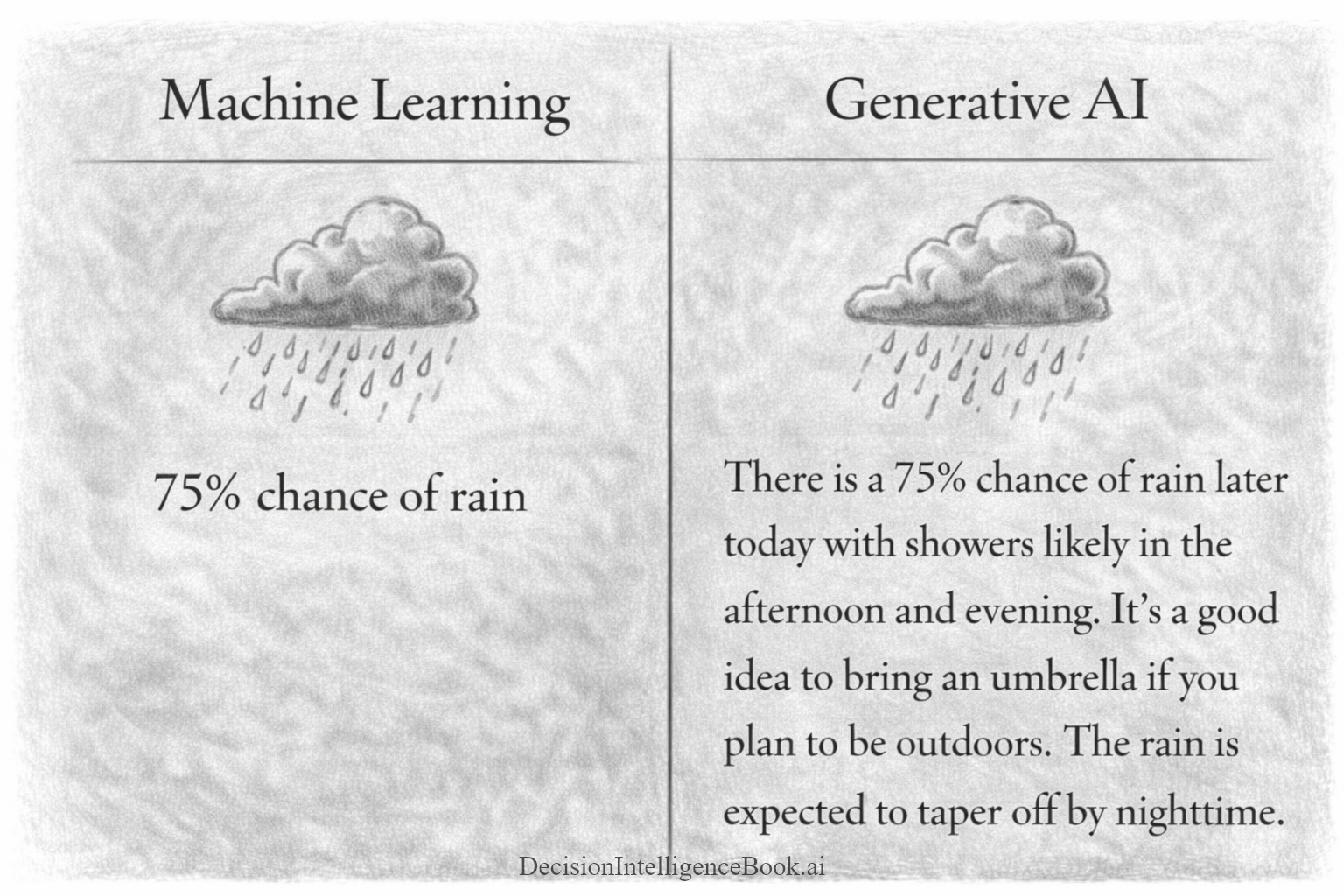
Generative AI dramatically changes how software can handle decision communication because it can generate natural language explanations across any step of the decision process. In the recent past, Machine Learning systems or AI systems that pre-date Generative AI could usually communicate only basic components of a decision. For example, a Machine Learning system could output a probability, score, or label plus a few explainability metrics. However, it was still up to the data scientist or analyst to interpret those decision forecasts. Therefore, using Generative AI for decision communication can be a game changer.
Note the illustration below of a rain forecast using probabilities. The panel on the left showcases a simple probability of rain, as a text-based decision recommendation cannot be generated simply with traditional Machine Learning models. Contrast this with the panel on the right, which shows how Generative AI can generate the probabilistic forecast, provide evidence and communicate additional details.
Generative AI can be given richer context about every step of the decision process. For communication, that is powerful because you can guide the model to use proven structures instead of rambling. For example, you can ask it to use answer-first structure like the Minto Pyramid (start with the main message, then supporting points, then evidence), or a bottom line up front (BLUF) style for busy readers. You can also tailor the same decision to different audiences: a direct, empathetic version for impacted employees; a short action-oriented version for managers; and a detailed quantitative version for executives. In practice, organizations can combine traditional analytics (like grouping employees into segments) with generative AI to produce messaging that is tailored to each group.
Generative AI also makes it easier to apply communication discipline consistently. A model can be instructed to communicate directly like Rasiah, structure the message top-down like the Minto Pyramid, or handle a difficult recommendation with SBIR. It can also generate multiple audience-specific versions of the same decision and explicitly communicate confidence, assumptions, and uncertainty instead of producing one generic answer.