Chapter 1D
Decision Execution
 Decision Intelligence – Decision Execution with Intuition
Introducing Decision Execution

Once the options have been framed and intelligence gathered, the third step in the Decision-Intelligence Framework is Decision Execution. In this phase, an individual, team, or organization turns its conclusion into action: chosen options become concrete tasks, resource commitments, and measurable outcomes. This sounds very fancy, but Decision Execution can be as simple as selecting a dinner option from a menu and enjoying the meal.
At its simplest, Decision Execution is selecting from options. Most of these decisions are executed subconsciously without much thought. For example, selecting an apple to eat from a basket of apples. The decision execution is simple and happens fast. However, Decision Execution can take many interesting forms. Decision Execution can also mean not choosing: passing on all options, postponing a decision, or quitting altogether. Annie Duke dedicates an entire book to this form of decision execution (linked in the modules). In her book, Annie Duke illustrates that optimal execution sometimes means stopping (quitting) rather than starting.
It is also important to note that Decision Execution is not always carried out on our own behalf. We often design execution plans for others. A financial planner, for instance, gathers intelligence on a family’s retirement goals, presents several strategies, and leaves the family to implement the path they select.
📰 Case Study: "Do Nothing" Heinz Strategic Decision Execution: In 2010 the “corn-syrup scare” hit U.S. grocery aisles. ConAgra reformulated every bottle of Hunt’s, trumpeting a new recipe sweetened only with cane sugar. Heinz debated whether it, too, should rip the high-fructose corn syrup out of its proven ketchup formula, but consumer testing showed shoppers were perfectly happy with the taste they already knew. So Heinz chose a minimal response: keep the flagship ketchup formula exactly the same and quietly launch a small off-shoot called “Simply Heinz,” which used sugar for the minority that really cared, while it focused its effort (and ad dollars) on new packs like the Dip & Squeeze pouch. The outcome vindicated the “Do Nothing" strategy. What happened? Sales of Hunt’s sugar-only ketchup stalled so badly that ConAgra put corn syrup back less than two years later, while Heinz retained its dominant share without ever tampering with the taste most consumers expected.
Why Optimization of Decision Execution Matters
Great approaches to decisions are only half the battle. Real value shows up when you optimize the decision execution process. Let's take a quick look why optimizing Decision Execution is important:
- Good Plans Die in Execution: Research shows that about two-thirds of company strategies never pay off because people struggle to turn strategic plans into meaningful actions.
- Speed Beats Perfect in a Fast World: Firms that can decide and act quickly grow faster and earn more profit than slower rivals. Individuals that can decide effectively are much likely to progress faster in multiple tasks, and are also less likely to procrastinate.
- Having the Right Tools to Execute Decisions: Once you have the proper framing and gathered the intelligence, you need proper Decision Execution tools to be able to make decisions actionable. For example, if you have gathered the most perfect intelligence on your competition, not having the right analytical or AI tools will not help you optimize execution.
- Scaling Decisions: Big decisions typically involve multiple teams and moving parts. Effective team decisions need to converge on a decision. Strong execution ensures all those pieces work in sync and are coordinated appropriately. A great team decision is seconded, thirded etc. by each team member.
- Explaining the Decision Execution aids in Transparency: Decisions that can be explained in why and how they will be executed allows everyone in the decision-making process to operate on the same level of information.
Three Forms of Decision Execution
As illustrated in the earlier section, Decision Execution can be optimized several different ways by using the right execution tools, scaling options, execution explainability, execution speed, implementation of framed gathered intelligence. Therefore, Decision Execution warrants its own breakdown of subcomponents in how decisions can be optimized further.
For the Decision Intelligence Framework, I introduce the following taxonomy for Decision Execution. All decision execution (from simple to complex) can be categorized into these three forms (areas):
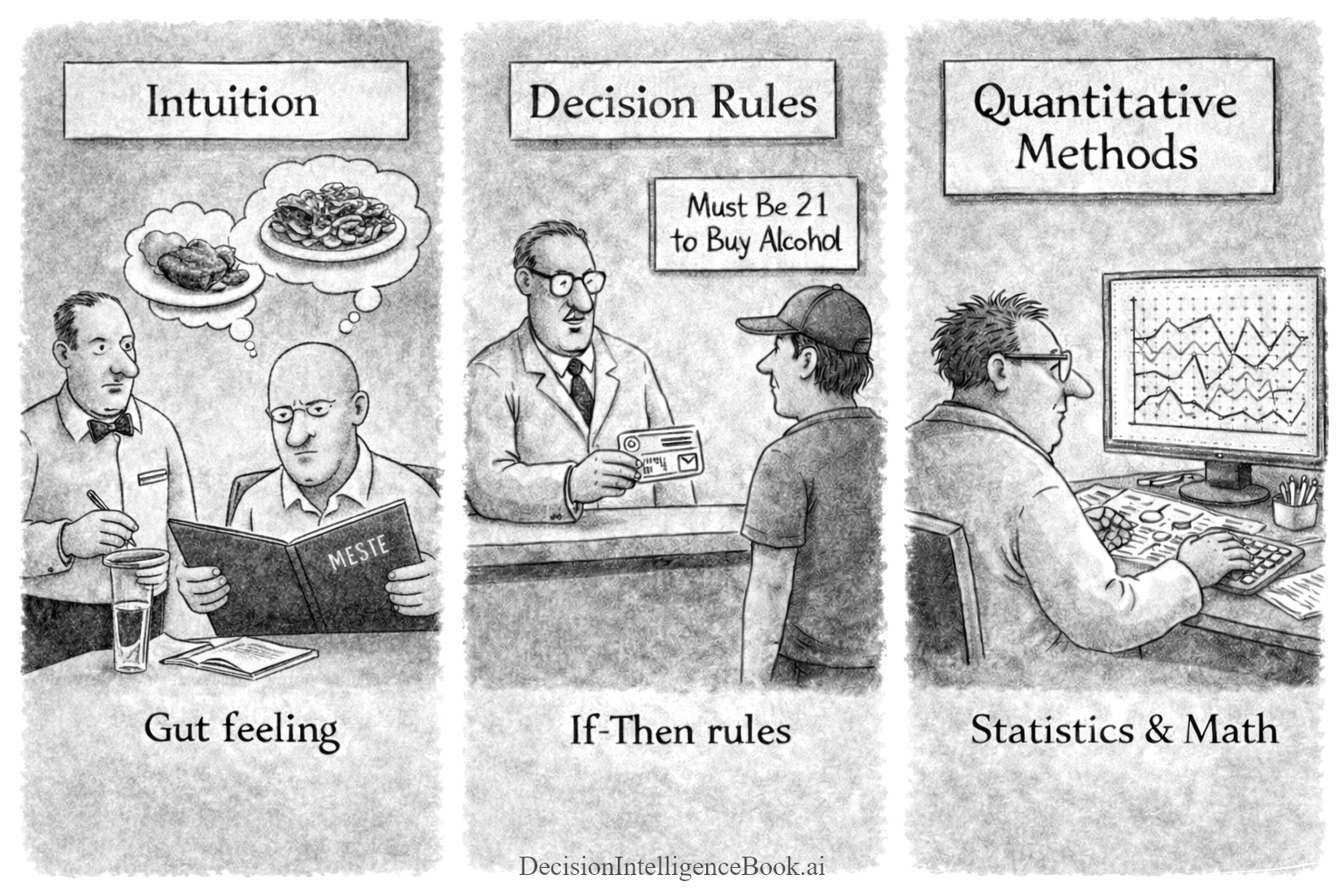
- Intuition: When speed is paramount and the stakes are low to moderate (grabbing an apple, picking a dinner entrée, deciding when to brake while driving), we lean on pattern recognition built from experience. Intuitive execution minimizes cognitive load, letting the brain convert scattered cues into an instantaneous “go” signal. Intuition execution is how most of your daily decisions are made. However, intuition has many issues and it is not recommended for high stakes decisions. For example, decision based on intuition remain vulnerable to human bias and overconfidence when the environment changes.
- Decision Rules: For recurring choices that benefit from uniformity: bank lending thresholds, emergency room triage, airline pre-flight checklists you can encode experience into explicit if-then rules or checklists. These codified procedures reduce variance, make training easier, and free scarce attention for the truly novel cases, but they work only when the rules are periodically audited and updated. For example, you need to be 21 years old to purchase alcohol or cigarettes is a simple codified decision rule that is very easy to execute for a clerk at a store.
- Quantitative Methods: High stakes and data-driven decisions (launching a product, optimizing an advertising budget, hedging a commodity price) warrant mathematical rigor: statistical analysis, Monte Carlo simulations, Bayesian updates, and other probabilistic optimization algorithms. Such tools surface probabilistic trade-offs invisible to intuition or rules alone, but they demand the time and expertise for careful translation into executable actions.
Three Forms of Decision Execution Compared
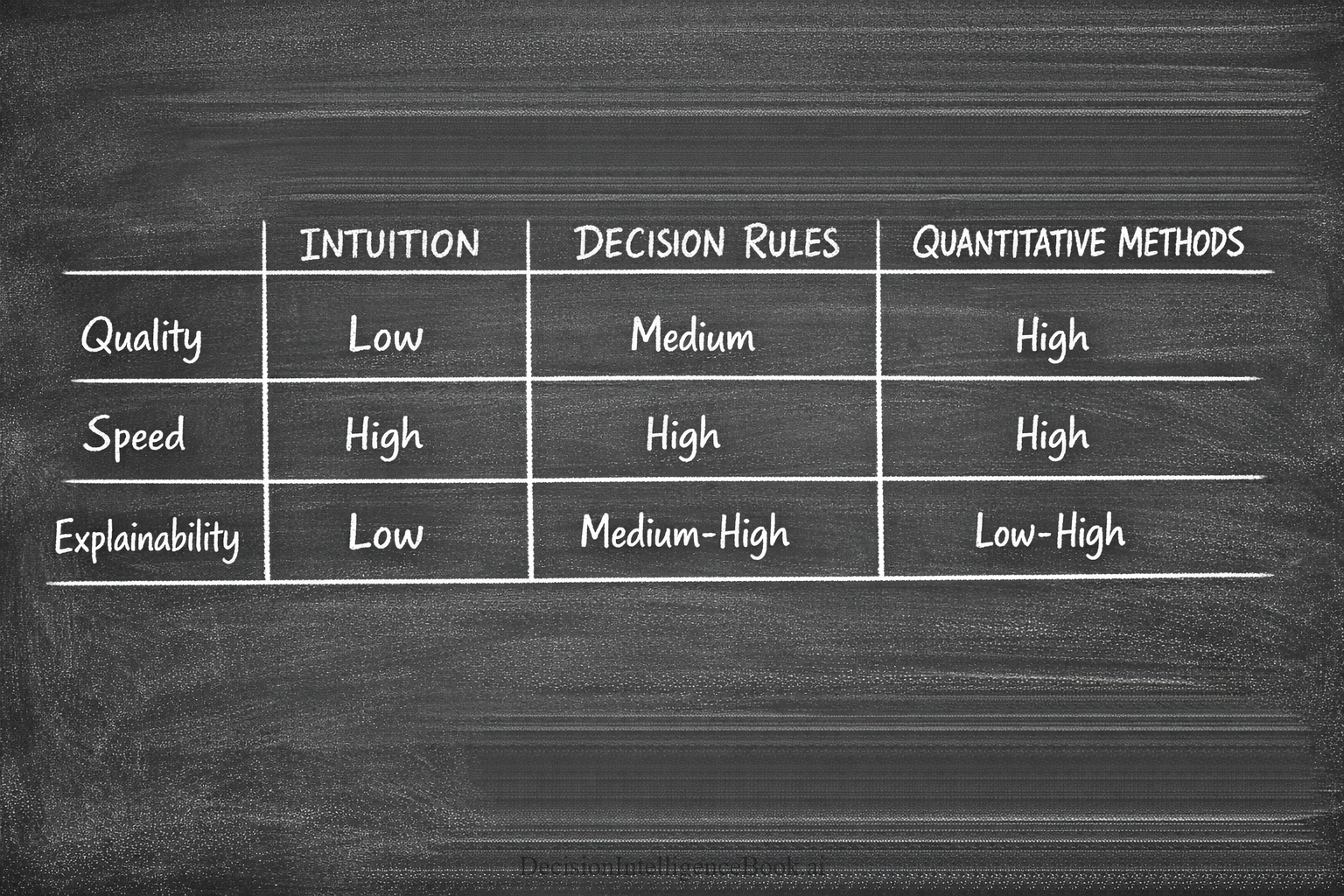
The illustration above is a quick way to compare characteristics of three common ways make decisions are executed. The idea is simple: different decisions need different tools. Gut Feeling is usually fast, but it can be less reliable and hard to explain. Decision Rules are great for repeatable situations because they’re quick and consistent, as long as the rules are kept up to date. Quantitative Methods can produce the highest quality decisions when the stakes are high, but they may take more time and effort, especially when you need good input data, analysis, and careful interpretation.
Lets break down the comparison into more detail for each of the decision forms (tools):
Intuition
A judgment based on experience and pattern recognition
- Quality (Low): Often works well in familiar environments where you’ve built real pattern-recognition (driving, routine work). In those situations the quality is usually good enough. But quality drops when conditions change, feedback is weak/delayed, or the problem is new/complex. This is because intuition quality is vulnerable to bias, overconfidence, and usually doesn't work without previous patterns.
- Speed (High): Near-instant. Daniel Kahneman calls this "thinking fast". It requires minimal cognitive load. In fact, if you are driving in familiar places you can almost go into "intuition autopilot" and use your cognition on other tasks (thinking about important tasks while you drive). The speed of intuition is a great asset when you must act quickly or the cost of being slightly wrong is small.
- Explainability (Low): Intuition based decision are hard to articulate beyond “it felt right.” Even when the choice is correct, the reasoning is usually implicit and difficult to audit or teach. Explainability for decisions performed by human experts and forecasters can be more transparent, but usually remains on the lower side compared to other techniques.
Decision Rules
A checklist, threshold, or if/then rule applied to a repeatable situation
- Quality (Medium): Good when the situation is repeatable and the rule captures known best practice (thresholds, checklists, if/then). Quality is limited by what the rule doesn’t cover: edge cases, shifting environments, and outdated assumptions. With regular review and updates, quality can be very strong for its target scope.
- Speed (High): Fast to execute once the rule exists. Most decision rules are quite simple and have a context and at most 2-3 input parameters. Therefore, even if math is involved, it can be done quickly in your mind or using a cell phone.
- Explainability (Medium-High): Usually clear. For example, "The organization did X because the rule says if A then B.” Easy to create decision records, justify and audit the explainability. It does require the rules to be documented as a reference.
Quantitative Methods
Models or analyses that use math to estimate outcomes, risk, and tradeoffs
- Quality (High): Best for high-stakes decisions where uncertainty reduction matters. Methods like statistical analysis, simulations, and probabilistic optimization can reveal expected value, risk, and sensitivity. Quality depends heavily on model validity and input data; bad data or bad assumptions can still produce confident-but-wrong outputs. However, when used correctly, the quality for quantitative based decisions is high.
- Speed (Low-High): Ranges widely. Some models can be run quickly once built (high speed in execution), but building/validating them can be slow (low speed in setup). For example, an automated machine learning system that makes a decision on classifying junk mail can make the decision almost instantaneously. However, that machine learning model took an investment of resources to build. Furthermore, you can have quantitative models that are very fast to execute with AI or Machine learning, but they require many inputs. This can dramatically increase the time cost rises with data collection, data cleaning, extracting intelligence etc.
- Explainability (Low-High): Typically high because you can show the inputs, assumptions, and logic (equations, distributions, scenarios) of the quantitative models. Explainability drops if the model is overly complex or a “black box” without good interpretation. The recommendation to keep explainability high is to use interpretable models (statistics, machine learning, analytics, math) and stay away from non-interpretable models (neural networks, certain ML algorithms).